Purpose-built for validating AI servers, high-power laser optical engines, and aerospace propulsion modules—designed for "extreme heat flux > 100 W/cm²", delivering precise heat dissipation limit validation.
Single-phase water cooling has no absolute heat dissipation limit, but in practice it can only mitigate the issue by narrowing microchannels and increasing flow rate—at the cost of excessive pumping power, pipe erosion, and drastically reduced filter lifespan. Moving to two-phase flow is the more practical solution.
The coolant maintains a constant saturation temperature throughout the phase change, ensuring uniform cold plate surface temperature and significantly reducing silicon chip warpage.
By utilizing vaporization latent heat, the required flow rate is far below single-phase water cooling; when handling extreme heat flux, pumping power is roughly six times lower than a single-phase system.
Advanced cold plate design enables the coolant to fully vaporize as it exits—every drop of liquid coolant the pump delivers is perfectly converted into heat dissipation capacity.
Using dielectric coolant, even in the event of leakage, IT equipment is protected from short-circuit burnout—fundamentally improving data center reliability.
TAI YIAEH independently developed a 500W air-cooled PTPC demo unit, built on a full industrial aluminum extrusion frame. The front panel integrates three real-time temperature displays; the side panel features a visible window for direct observation of high-density nucleate boiling inside the cold plate—two-phase flow is not a specification on paper, but visible physical reality.
This demo unit reproduces the complete PTPC core loop in miniature: Heat Source Simulation → Cold Plate Nucleate Boiling → Vapor Transport → Air-Cooled Condensation → Liquid Return. The air-cooled condensation design eliminates the need for an external water chiller—just plug it in and it runs, making it easy to demonstrate on-site at customer facilities or exhibitions.
* These videos show the 500W air-cooled demo unit, used for on-site demonstration and educational validation; mass-production PTPC measurement systems are rated at 1000–2000W (including water-cooled chiller)—see full specifications below.
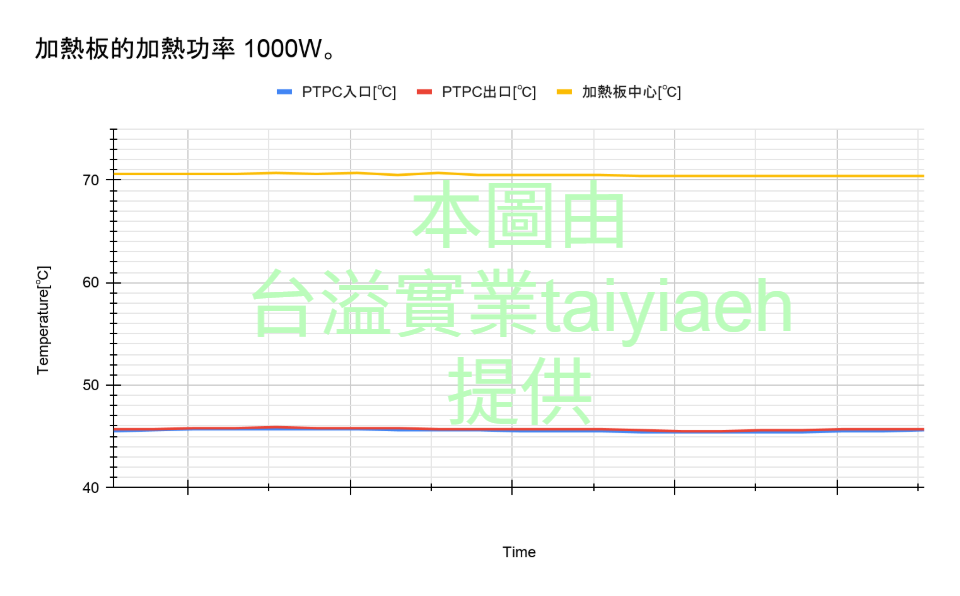
At a heating power of 1000W, constant-temperature two-phase flow keeps the cold plate inlet and outlet temperatures nearly identical (isothermal), with the heating center staying at around 70°C—true, measured proof of excellent isothermality.
Live HMI screen recording—with coolant water at 36.1°C, the cold plate temperature stays stable at 38.4–38.6°C.
Heating power 1000W. Inlet and outlet temperatures are nearly identical (isothermal), with the heating center maintained at about 70°C—stable and uniform heat dissipation. (Chart labels in Chinese.)
▲ Original measured data provided by TAI YIAEH (taiyiaeh)
The industrial-grade two-phase test platform—precise measurement and protection all the way from heat source simulation to condensation and heat rejection.
| Simulated Heat Load | 1000 W ~ 2000 W (expandable on demand), stepless precision control. |
|---|---|
| Working Fluid | Compatible with non-conductive, eco-friendly dielectric coolant (no short-circuit risk). |
| Extreme Heat Source Simulator | Aluminum block heating fixture (customizable). |
| Circulation Power Core | Driven by a high-grade refrigerant pump; flow rate designed per requirement and dynamically adjustable. |
| High-Precision Flow Measurement | Refrigerant flow meter, 100% leak-free. |
| Condensing & Heat Rejection | Plate heat exchanger efficiently condenses vaporized coolant back to liquid. |
| Piping & Sealing Protection | PTFE (fluoropolymer) materials; equipped with a visible window for observing high-density nucleate boiling. |
| Facility Requirements | Control and pump: three-phase 220 V. Chiller included. |
Enter a target wattage for steady-state measurement.
The heat source is cut off the moment its temperature exceeds the safety limit (e.g., 85°C).
An HMI-automated pre-charge procedure ensures no non-condensable gases remain in the system (patent pending).
Please fill out the form and we'll get back to you within 1 business day.